
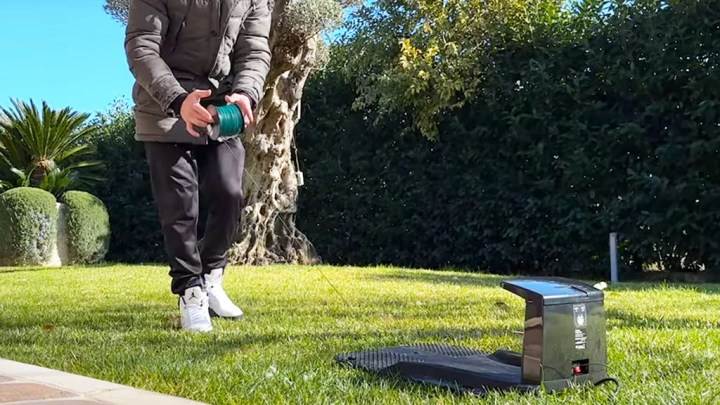
Do I have to lay the boundary wire underground?
When we buy a robotic lawnmower, we also need to prepare our garden accordingly. There is a need to place the boundary wire, which helps the lawn mower remain inside the lawn area. However, most experts recommend laying the boundary wire underground for easy operation. The question that arises here is whether it is mandatory to do so. The wire placed acts as a navigator or signal generator. It informs the device which areas it can traverse and which are out of bounds. Let us know if laying the boundary wire underground is critical or if even outward placement would suffice. How is the perimeter wire placed Placing of the wire is relatively simple. It is fixed to a charging station and then placed around the entire area. In the end, it again comes back to the charging station. Due to the charging station, there remains a magnetic field in the wire. It is this field that helps the robotic lawn mower to move around. However, the perimeter wire must be undamaged, and you must not exceed the length mentioned by the manufacturer. Remember that Installing boundary wire is the most critical aspect of using a robotic lawn mower. When can you lay the perimeter wire above ground In case if you want to go for a simple option, then you should lay down the boundary wire above the ground. Just lay the wire around the garden once. Now fasten the wire with lawn nails as per the distance requirement that the manufacturer has mentioned. Soon the lawn will grow and cover the wire, making it invisible. Advantages and disadvantages of above-ground laying of perimeter wire Let us know move on to learn the basic advantages of laying the perimeter wire above the ground: The laying process is simple If there is a mistake, you can quickly alter the arrangement Later if there is a readjustment required, you can do so without much hassle. However, the process has its own share of disadvantages which are: The perimeter wire remains exposed to elements like rain, snow, wind, etc. The risk of weathering and corrosion due to exposure is high The wire could break after some time There is a chance of the wire getting cut due to any work going on in the garden. When should you do the underground installation of the perimeter wire Now we will talk about How to Install a Robot Mower Boundary Wire underground. Most manufacturers offer the facility of placing the perimeter wire underground. The advantages of the same are: Less risk and exposure to external elements The cable remains invisible to others There is very little chance of anybody noticing the wire The cables can transmit the signal with reduced problems up to 7 centimeters Disadvantages of Underground installation of perimeter wire are: You cannot change the design or placement once the installation is completed If there is an accident, it is tough to fix the problem Finding wire breaks is complicated; you need a tool to find it The laying process in itself is pretty tedious What you should keep in mind while laying the perimeter wire Whether you lay the wire underground or above it, you should keep it stretched. There should not be any crossing over, as that could hamper the signal. This, in turn, would affect the working of the robotic land mower. Most manufacturers mention the specification of wire distance from lawn edge and walls. It is wise to follow these instructions else you might have to redo the boundary again. Carelessness in this matter could also damage your robotic land mower. How to lay the underground wire for rolled turfs When you lay the boundary wire, you might feel like following the same process when laying the turf. However, this can be harmful in the long run. If there is any fault in the placement, it would be hard to fix it. You must first place the underground wire and then run the robotic lawnmower. If there is any issue, you will get to know it within a few days. Remember that after placing the turf, you have only three weeks to place the perimeter wire underground. After that, if you try, it would be difficult as the rooting has become hard. Instead of just sliding the wire inside, you can dig a channel and place the wire there. If you opt for the above-ground placement, then there is nothing that you are required to do. Which should you opt for Practically speaking, you can choose any of the above processes for laying the perimeter wire. Both have their share of pros and cons. If you need underground wire placement, remember it would be costly, especially if you are hiring a professional company to do the same. Yet the wire, once installed, is safe from damage due to any external factors. Once the installation is over, you do not have to keep checking again to know if everything is ok. If you are worried things could go wrong, you could first place the wire above the ground and later shift it underground. In nearly 80% of the cases, a correction in the wire placement is required. It is better to be safe than to repeat the process later on. Summing up The wire placement is integral for the successful use of Robotic lawnmowers. For best results, you can choose Hookii lawn mowers. These automatic lawnmowers are efficient and handle garden mowing with ease. They move systematically, and therefore the chances of wire getting damaged are pretty less. The Neomow product range is created with extreme precision. It moves logically around the entire garden and avoids obstacles if it senses its presence. There is an algorithm that the device uses and that helps it to move in a pattern. They can mow up to 1000 m square, and you can relax while it mows carefully. The presence of a brushless motor, high-capacity battery, and dual off-road tires ensures…